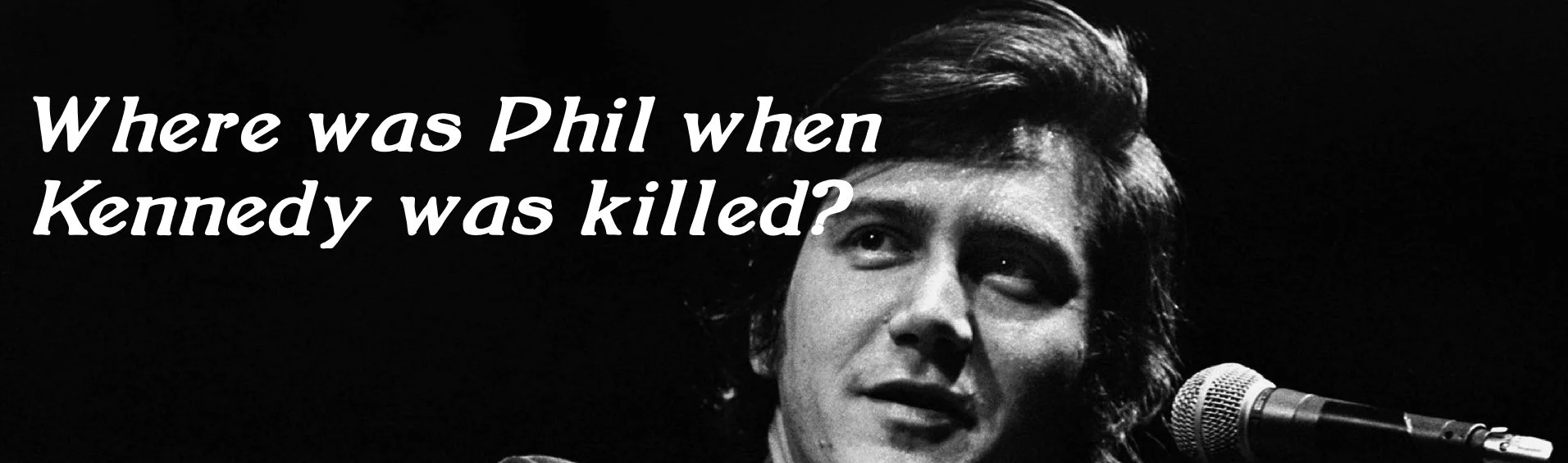
The Greenwich Village folksingers of the 1960s are well known for being the most outspoken protest songwriters of the 20th century. Phil Ochs was among the fiercest and most dedicated of them. Planning rallies, performing at countless fundraisers, protesting the Vietnam war: Ochs’ tenacity and dedication to leftist causes is revered, and rightfully so. At the very moment Bob Dylan shied away from politics, Ochs doubled down on his political convictions.
Yet, a puzzling rumor has circulated about the troubadour. Phil’s lifelong friend, Jim Glover, said Phil confided a dark and confounding secret to him: Phil was in Dealey Plaza in Dallas, Texas, on November 22nd, 1963, when President John F. Kennedy was assassinated.
Could this be true?
AN ALL-AMERICAN BOY
While Ochs would come to be known as an outspoken leftist, his roots were quite patriotic. The son of a World War II veteran and doctor, Ochs attended Staunton Military Academy— a prestigious military school in Virginia. There he was classmates with future Nixon White House Counsel, John Dean (of Watergate fame) and Barry Goldwater, Jr., son of the notorious, conservative Republican senator.
Ochs then attended Ohio State University, where participation in ROTC was mandatory. He rose the level of Lieutenant in the Air Force while at OSU. However, his love of folk music was beginning to emerge. Then, he met Glover.
Jim Glover was a red-diaper baby through and through. Born in Cleveland, Glover’s parents were involved in the Communist Party USA, hosting party meetings at their house— even housing the party leader (and eventual CPUSA Presidential candidate), Gus Hall, in their attic. Hall was on the lamb after being charged under the Smith Act for “advocating to overthrow the government”. The Glover household was ever-filled with the music of Woody Guthrie and Pete Seeger.
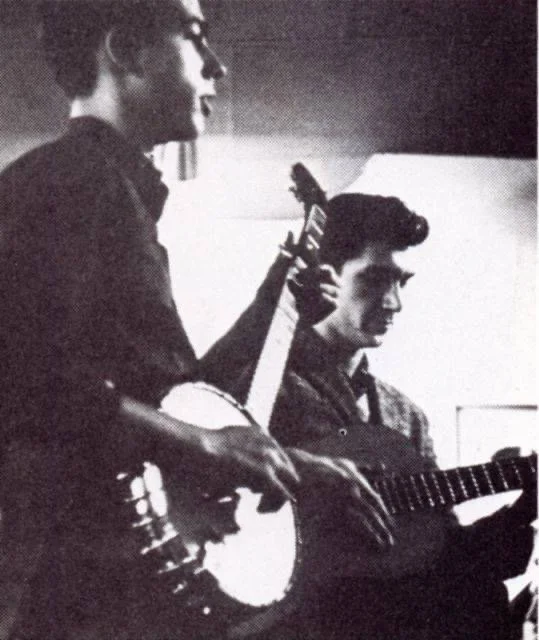
Jim Glover (left) and Phil Ochs performing at Ohio State University in 1960
Ochs met Glover and the two hit it off quickly. Glover showed Ochs the protest folk cannon and taught him how to play guitar. In fact, Ochs’ first guitar was Glover’s– he won it in a bet on the 1960 presidential election. Glover thought Nixon would win. Ochs disagreed, and won the bet. Their friendship blossomed and they formed a folk duo, “The Singing Socialists.” They gigged around folk clubs in Columbus but, after being pointedly questioned about their political alliances, Ochs swiftly insisted they change the band name to “The Sundowners”.
“Phil was pretty gung-ho military when we first met,” said Glover. “He knew about the Kingston Trio, but he didn’t know about Pete Seeger, Woody Guthrie, or any of that.”
While Ochs and Glover became fast friends, there were occasional hiccups in their relationship. Wernher von Braun, a NASA aerospace engineer and former Nazi collaborator, spoke at OSU in 1960. Glover joined a fellow student in protesting the event, handing out fliers outlining von Braun’s Hitler-allied association. Glover’s partner at the protest proudly wore his Socialist Worker’s Party jacket. Upon returning to his dorm, Glover found Ochs was angry.
“What are you doing? Don’t you know that guy’s a Socialist Worker’s Party guy?” Phil questioned.
“I don’t know, I just thought it was important that people knew that [von Braun] was a Nazi,” replied Glover.
On another occasion, Glover questioned the authority of his ROTC superior. He put his Army cap on backward (an affront to the uniform) and refused to march in their daily routines. “They’re going to get you now, man. They’re going to get you now.” replied Ochs.
Ochs frequently mentioned that Glover was “fair game” because of his communist past. Finally, Ochs admitted to Glover that there was a campus spying-program at OSU that Ochs was working with. These types of programs were rife on college campuses across the country as the anti-war and civil rights movements were taking off.
Ochs told Glover, “I’ll never lie to you, but there are some things I can’t tell you.”
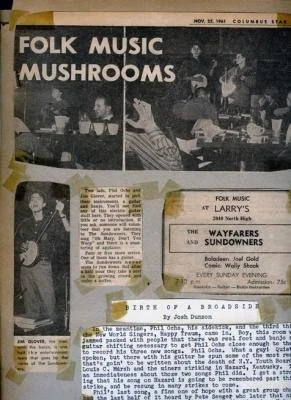
Ochs and Glover featured in the Columbus Star, performing at The Sacred Mushroom folk club in Ohio
WAS IT AN ACT?
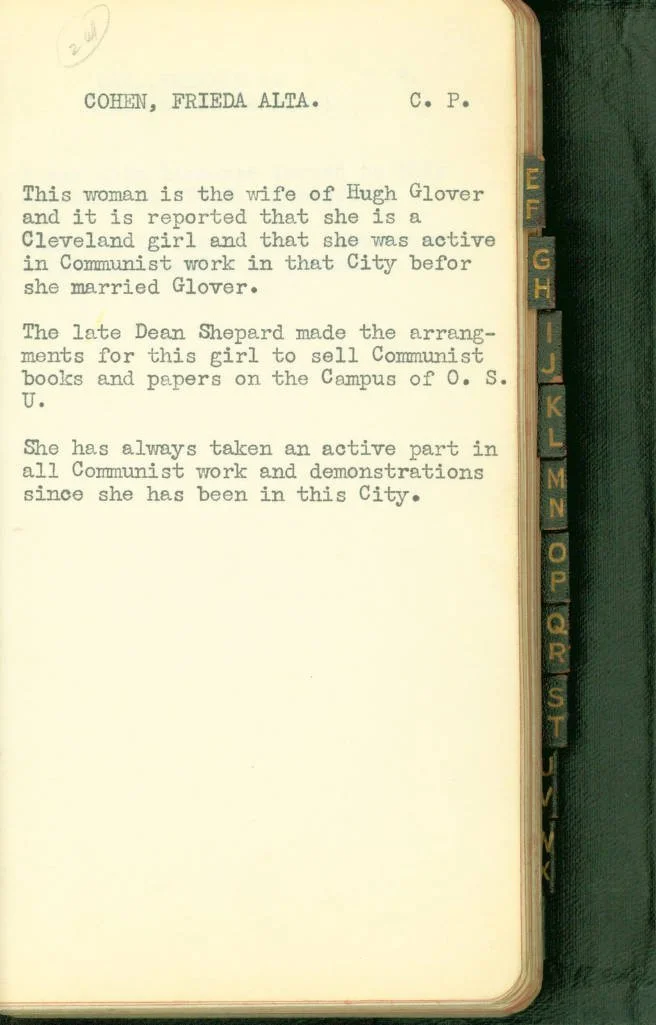
Despite his military connections, Ochs’ political awakening does appear to be in good faith. Ochs frequently attended dinner at the Glover household. Glover’s parents, Hugh and Frieda, were “fellow travelers” in CPUSA— a designation given to people involved in the party, but who wished to avoid the social and legal troubles directed at card-carrying members. Even still, Cleveland Police records had long-since cited Mr. & Mrs. Glover as being “of a dangerous nature”.
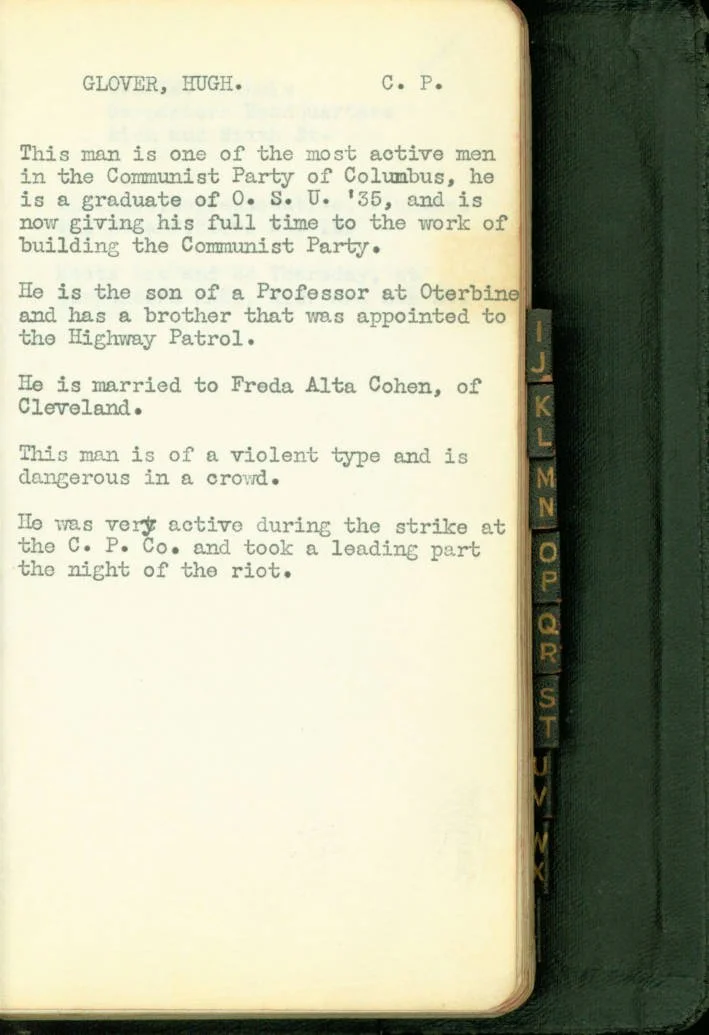
1940s Columbus Police Department records on Jim Glover’s parents, Hugh & Frieda
An avid reader and news junkie, Ochs soon began writing songs from what seems to be a socdem, patriotic perspective. His first song, “The Ballad of the Cuban Invasion”, is told from a viewpoint of a confused and disillusioned American:
Why were they wearing my country’s clothes?
Why were they spending my country’s gold?
Who are my friends and who are my foes?
The headlines were lying, why wasn’t I told?
Such tunes would eventually populate his first album, All the News Fit to Print. “One More Parade”, “Talkin’ Vietnam”, and “Ballad of William Worthy” all come from the perspective of a disillusioned peacenik college student, not necessarily a frothing radical. Ochs’ classic “Power and Glory” rings of patriotism, even while it criticizes the “land that’s still troubled by men who love to hate”:
Here is a land full of power and glory
Beauty that words cannot recall
Oh, her power shall rest on the strength of her freedom
Her glory shall rest on us all, on us all
GREENWICH VILLAGE
Glover moved to New York City to join the emerging folk music scene, and Ochs followed in due course. At legendary clubs like the Gaslight Cafe, the Bitter End, Gerde’s Folk City and Cafe Wha?, folk luminaries like Bob Dylan, Dave van Ronk and Joan Baez created the socially-conscious folk scene still revered today.
Glover joined up with his future wife Jean Ray to form the folk duo, Jim & Jean. Ochs became a solo act and emerged as an uncompromising and dedicated protest songwriter; a mouthpiece of the growing peace movement. He sold out shows at Carnegie Hall, as folkies came to hear his delightful blend of biting social commentary, soaring melody, and sardonic wit. Ochs regularly passed up paying gigs to play for free at protests and rallies. As the early 60s counterculture emerged, this new wave of folk singers were at the forefront of radicalism.
In 1963, Glover and Ochs were living together at 163 Thompson st. in Greenwich Village. One day, according to Glover, Ochs came home flustered and flatly asked him:
“I heard there’s a plot to kill JFK. Have you heard anything about it?”
Jim said that he hadn’t, but wanted to know where Phil was getting his information. Phil admitted he was working with, “National Security— it was kind of like the CIA, but domestic. J. Edgar Hoover is the bad guy.”
Learning nothing from Glover, Ochs then said he was going to the Fair Play for Cuba Committee to try and find out more. (The FPCC was the organization that Lee Harvey Oswald was working, or pretending to work, for in New Orleans, just a few months before the assassination.) Years later, Glover contacted the head of FPCC, VT Lee, who confirmed Ochs had indeed been working with them.
At that time, Jim didn’t know what to make of any of this. Phil always seemed to know things: he predicted that Kennedy would defeat Nixon, he knew about the military plots to assassinate Castro, he’d even read about Lee Harvey Oswald’s defection to Russia in 1959. But this? This was quite a prediction.
Later that year, FBI agents showed up at the apartment. They wanted to know where Phil was. Glover, remembering that Phil told him Hoover was the bad guy, told them nothing. Phil’s FBI file confirms the Feds were looking for him in the Fall of ‘63.
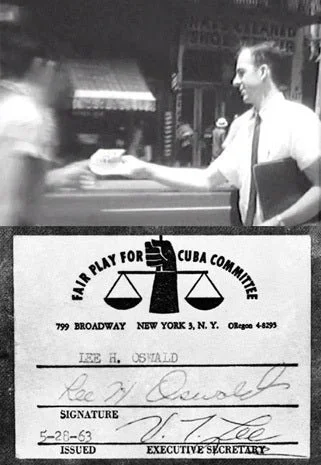
Oswald passing out fliers for the FPCC, and his membership card from May ‘63, signed by V.T. Lee
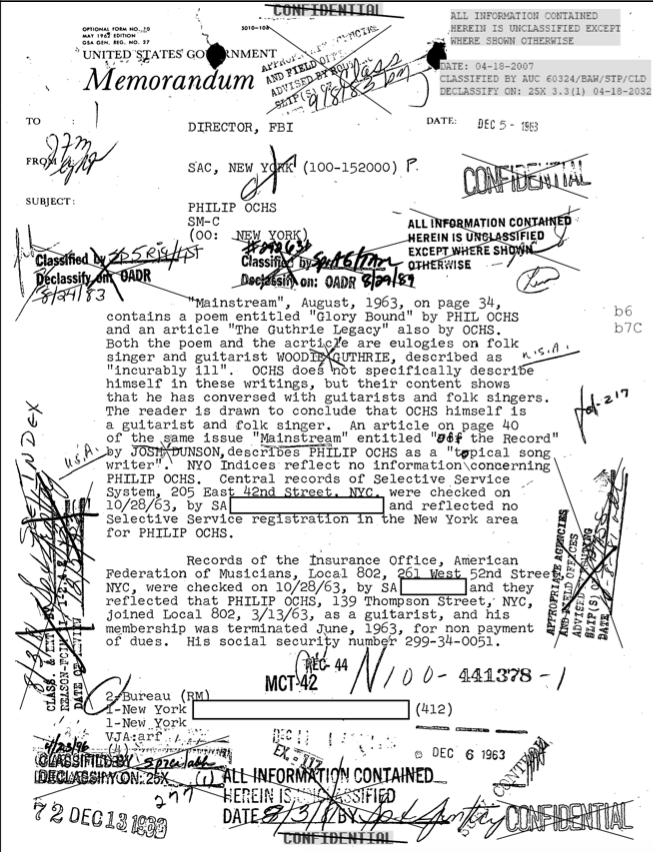
Page 1 of Phil Ochs’ FBI file, opened in 1963
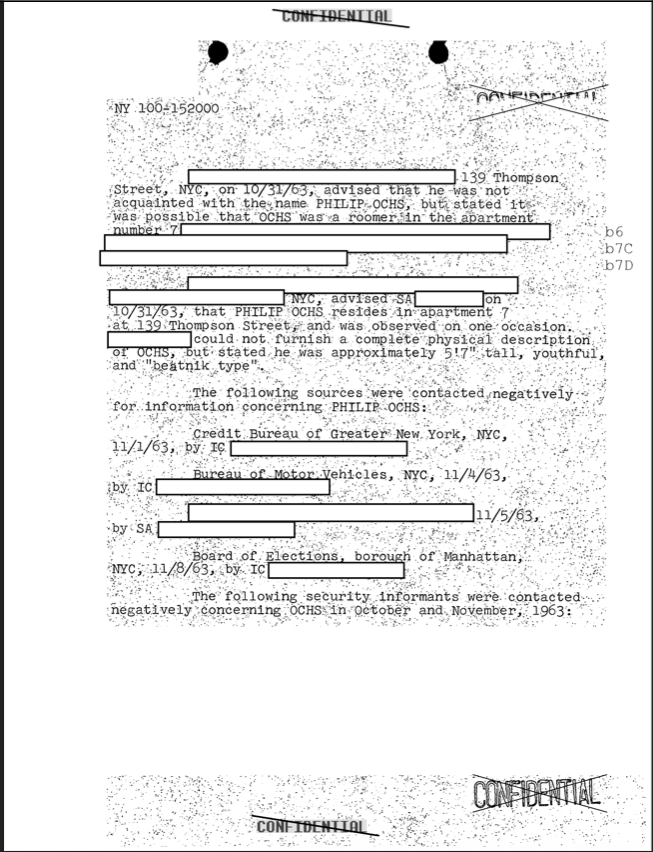
FBI Special Agents looking for Phil Ochs less than a month before the Kennedy assassination
THE ASSASSINATION
Sadly, Phil was correct. The assassination of John Kennedy remains a monumental and harrowing breakpoint in American history— to some, it was the country’s complete loss of innocence; to others, it was a military coup from which the country has never recovered; to all, it was a tragic moment in 20th century America.
The country laid in mourning through the end of 1963. Glover and Ray, still in their Thompson St. apartment, were on tour at the time of the assassination but returned to New York shortly thereafter. They hadn’t seen Phil since October. Then one day, he showed up at their apartment in January of 1964.
After telling Phil his own harrowing story on the day of the assassination (more on that in our forthcoming documentary), Jim asked Phil the question every American remembers: where were you when JFK was killed?
Phil looked his college roommate and old friend in the eye. “I was in Dallas.”
“What were you doing there?” was Jim’s next, logical question.
“I was sent there as a ‘National Security Observer’,” Phil replied. “I was in Dealey Plaza.”
“Well.. can you prove it?”
“Someone was filming me. I was standing in front of a garage door. There was a cameraman there, with a camera pointed at me.”
Glover never knew what to make of it. But, why would his oldest friend lie? There was certainly no benefit in admitting being in Dallas on 11/22/63. Especially not for a lefty, protest songwriter.
In 1988, a documentary, The Men Who Killed Kennedy, aired on A&E. Whether all of the film’s claims were accurate or not, the film contained a number of clips from the chaos of Dealey, shortly after the assassination. Among them, Glover found this:
All of this information and more is compiled in our forthcoming documentary, Psychic Cowboy.
If you’d like to learn more about the project, please email: scrapyardpictures@gmail.com
WHY WOULD PHIL BE THERE?
Is the above clip a smoking gun, proving Ochs was there? It’s too blurry to truly know. Glover, who passed in late 2025, always maintained that it was. Michael Ochs, Phil’s brother, denied the claim, saying he called Ochs at his Greenwich Village apartment that day. Two biographies about Ochs, Michael Schumacher’s There But for Fortune and Marc Eliot’s Death of Rebel, describe differing accounts of Phil being in New York. Schumacher writes that Phil told his wife Alice, “I think I’m going to die tonight.”
In 1964, while on stage, Glover told a crowd at the Gaslight Cafe that Ochs was in Dealey Plaza. After the gig, Ochs was incensed, “What are you trying to do? Get me killed?” Throughout their lifelong friendship, Glover urged Ochs tell his story. He flatly refused. While Ochs feared for his life, he was also concerned about his legacy. If the left knew he was connected to some National Security-apparatus, no matter how tangentially or for what purpose, his reputation as a mouthpiece of the counterculture would be ruined. Glover maintained that Ochs was searching for the truth, always trying to find the good guys. But this connection, coupled with the gravity of the assassination, would be too much for anyone to handle.
Glover was the only one who claimed Ochs was in Dealey. But, his story remained remarkably consistent for more than 50+ years. In Glover’s defense, if this was true, Ochs obviously wouldn’t share this information with anyone outside of his small circle of friends. Even if others close to him knew, they would be sure to protect his secret, knowing full well how explosive this could be.
The obvious question: why would they send him to Dealey Plaza?
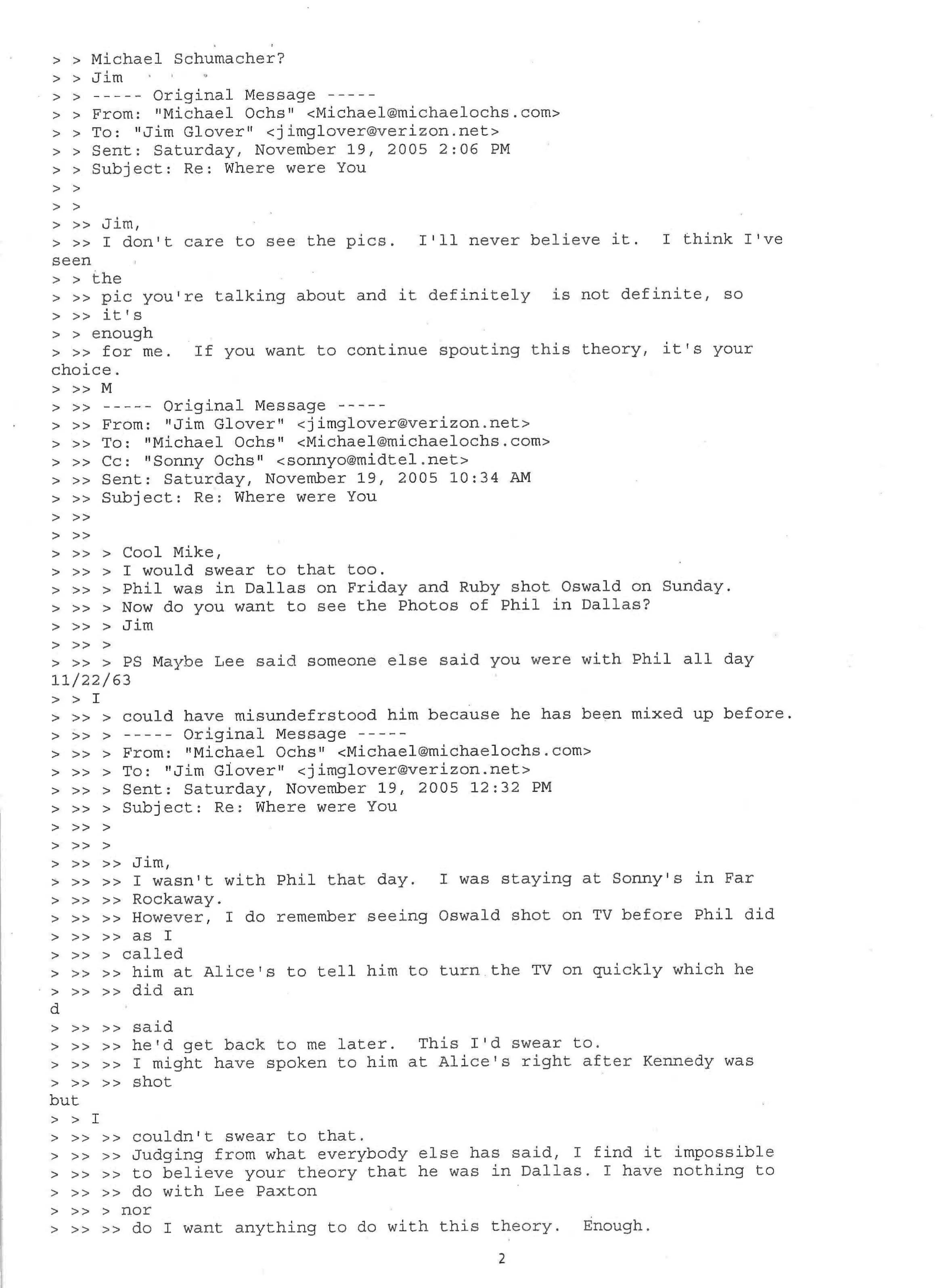
2005 email exchange between Jim Glover and Michael Ochs— Michael denies Jim’s claim
Keep in mind, even well into his junior year at Ohio State, Ochs was criticizing Glover for his leftist values. But as he and Glover grew closer, and the country engaged in a string of brutal interventions and military humiliations, Ochs’ political leanings began to change for good.
He believed in America, but hated what it was becoming. This change of heart was the engine of his songwriting. His military contacts, who likely experienced no such softening of their attitudes, couldn’t have been pleased with Ochs’ work. In the lead up to November ‘63, Ochs only became more radical— and more popular.
So, why send Ochs to Dallas? To shut him up.
Civil rights attorney and JFK researcher, Bill Simpich, discusses why Phil Ochs may have been in Dealey Plaza
All of this information and more is compiled in our forthcoming documentary, Psychic Cowboy.
If you’d like to learn more about the project, please email: scrapyardpictures@gmail.com
But Ochs, to his tremendous credit, refused to go quietly. While he would never talk about his involvement publicly, Ochs proceeded to become arguably the most prolific and outspoken protest songwriter of the 1960s. As Bob Dylan and others retreated to folk rock and love songs- Phil was palling around with Abbie Hoffman and Jerry Rubin, still stumping at anti-war rallies and singing increasingly anti-imperialist, anti-capitalist tunes.
Glover claimed Ochs repeatedly told him that he couldn’t talk about his whereabouts on 11/22 but, he wrote a song about it. Ochs’ seminal track, “Crucifixion,” famously chronicles the Kennedy assassination. The story of Ochs performing the song for Bobby Kennedy (and bringing Kennedy to tears) is widely-known, as well. But, its full context may remain a mystery. The song does, of course, include hints of Ochs’ premonition:
They say they can't believe it, it's a sacrilegious shame
Now, who would want to hurt such a hero of the game?
But you know I predicted it, I knew he had to fall
Glover insisted Ochs left clues in other songs, as well. From his 1970 track, “One Way Ticket Home”:
Does anybody know my name, or recognize my face?
I must have come from somewhere, but I can’t recall the place
They dropped me at the matinee, they left without a trace
Ticket home, I want a ticket home
Elvis Presley is the king, I was at his crowning
My life just flashed before my eyes, I must be drowning
Ochs had a lifelong fascination with Elvis, but these lyrics map all too easily to the events of Dealey. “I was at his crowning...”
Ochs even used to joke on stage, “Well, as you know, I’m a folk singer for the FBI.”
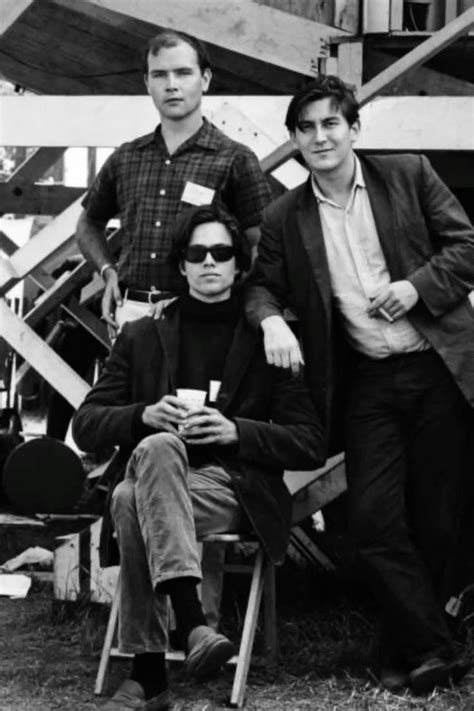
Tom Paxton, Phil Ochs and Eric Andersen at the 1963 Newport Folk Festival
From Ochs’ 1969 song, “My Life:”
My life was once a flag to me
And I waved it and behaved like I was told
My life was once a drag to me
And I loudly and I proudly lost control
I was drawn by a dream
I was loved by a lie
Every serf on the scene
Begged me to buy
But I slipped through the scheme
So lucky to fail
My life was not for sale
My life is now a myth to me
Like the drifter, with his laughter in the dawn
My life is now a death to me
So I'll mold it and I'll hold it 'til I'm born
So I turned to the land
Where I'm so out of place
Throw a curse on the plan
In return for the grace
To know where I stand
Take everything I own
Take your tap from my phone
And leave my life alone
My life alone
UNSTOPPABLE
And so Ochs continued on. He organized two “The War is Over” rallies (before the Vietnam war actually concluded) in Los Angeles and New York City- singing and marching alongside thousands of demonstrators. He was arrested in Chicago, alongside Yippie leaders Abbie Hoffman and Jerry Rubin, at the infamous ‘68 DNC and later testified in court on behalf of the defendants.
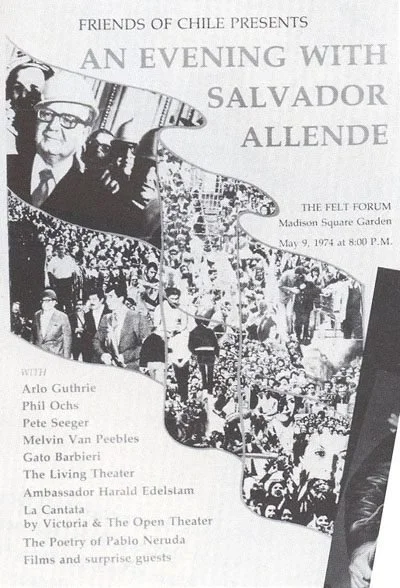
He produced the “An Evening with Salvador Allende” benefit concert at Madison Square Garden in 1974, after the US toppled the leftist regime in Chile. Ochs and the fellow organizers were openly stalked and monitored by FBI agents in the lead up to the show. Co-organizer Deni Frand said, “There was a sense of vulnerability because you knew you had the FBI around, or the CIA around. It was a real feeling. We didn’t manufacture it.” Arthur Gorson, Ochs’ manager, added, “We had the feeling that we were under constant surveillance. Our phones were tapped. I had people watching my house from across the way.”
When the US government finally did end the campaign in Vietnam, Ochs put on one last “The War is Over” concert in Central Park. Over 50,000 people attended.
His commitment was clear. He would not be silenced.
FINAL CONNECTIONS
Ochs’ depression, alcoholism and bipolar disorder would consume the latter years of his life— all leading to his suicide in 1976, at the age of 35. In many ways, Ochs warned of his own death. He felt the dream of America had died at the ‘68 DNC. His album released the following year, Rehearsals for Retirement, featured his own gravestone on the cover.
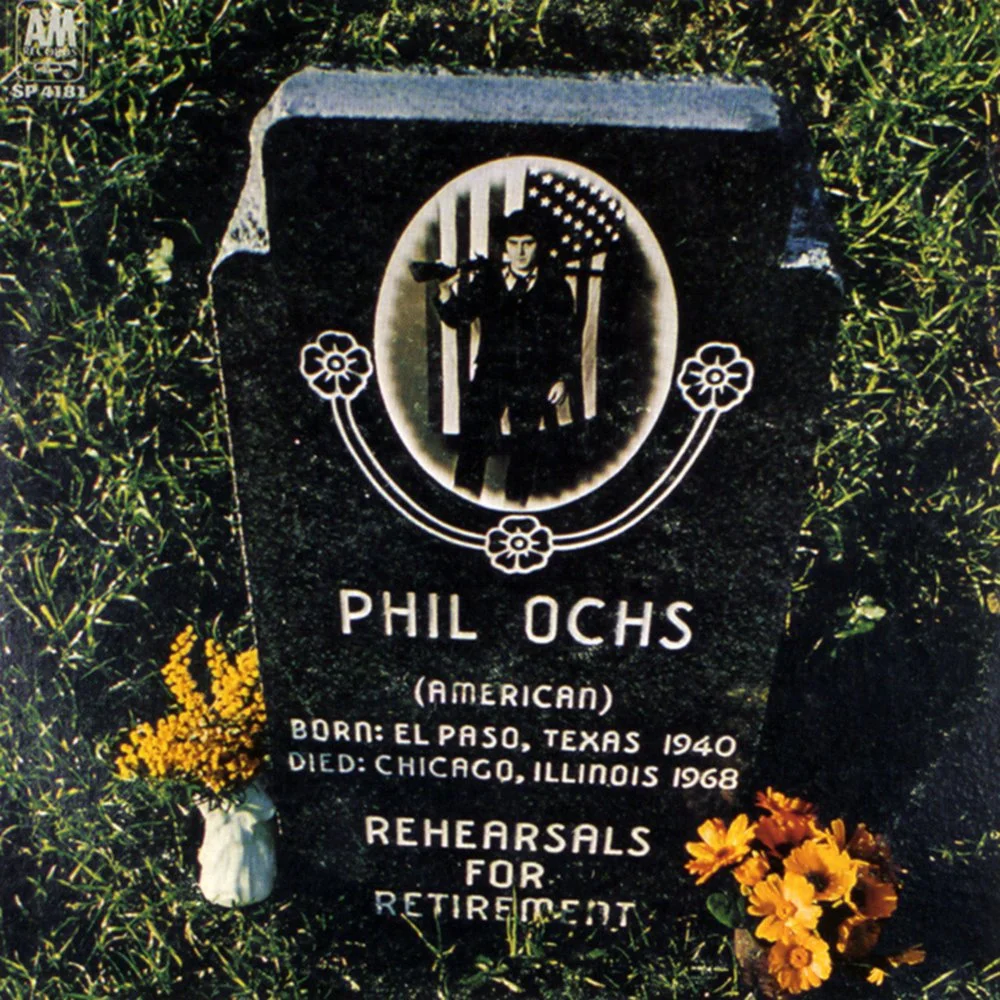
The cover art for Ochs’ 1969 album, Rehearsals for Retirement
His final few years were marred by erratic behavior, stilted songwriting, and alcoholic fits that alienated him from both friends and family. But there are two incidents worth mentioning.
In the early 70s, disgusted with the American scene, Ochs traveled the world. He visited South America, accompanied by David Ifshin (then-President of the National Students Association, a notoriously CIA-funded organization). In 1973, Ochs visited various countries in Africa and even wrote and recorded a single, “Bwatue”, in ‘73 with two fellow African musicians.
Late one night in Tanzania, Ochs was attacked and robbed. His assailants choked him so badly, he lost the top three notes of his vocal range.
The attackers left Ochs’ wallet, money, and passport— they took only his knife. Phil, although tremendously paranoid at this time, maintained that the attack was orchestrated by US agents.
One night back in New York, Phil showed up at folk stalwarts, Sis and Gordon Cunningham’s, apartment, “Somebody’s got to hide me.” Phil insisted assassins were waiting for him in the lobby of the building. Sis said later, “We didn’t know if he was fantasizing or something, but after he died and we were thinking this over, I believe it was true. We know now that he was under surveillance. The FBI reports showed that.”
JOHN TRAIN KILLS PHIL
Then in 1975, as his mental state declined further, Ochs announced that he was now John Train. He began telling everyone he met that John Train had killed Phil Ochs. “The reason I killed him was he was some kind of genius but he drank too much and was becoming a boring old fart. For the good of societies, public and secret, he needed to be gotten rid of,” claimed Train.
Setting aside the not impossible prospect that John Train may have been some sort of MK-ULTRA alter-personality of Ochs’, it’s worth investigating who John Train was. Michael Schumacher, one of Ochs’ biographers, claims Ochs got the name “from [his] big-screen heroes John Ford and John Wayne,”
However, there was another John Train alive at this time, as well.
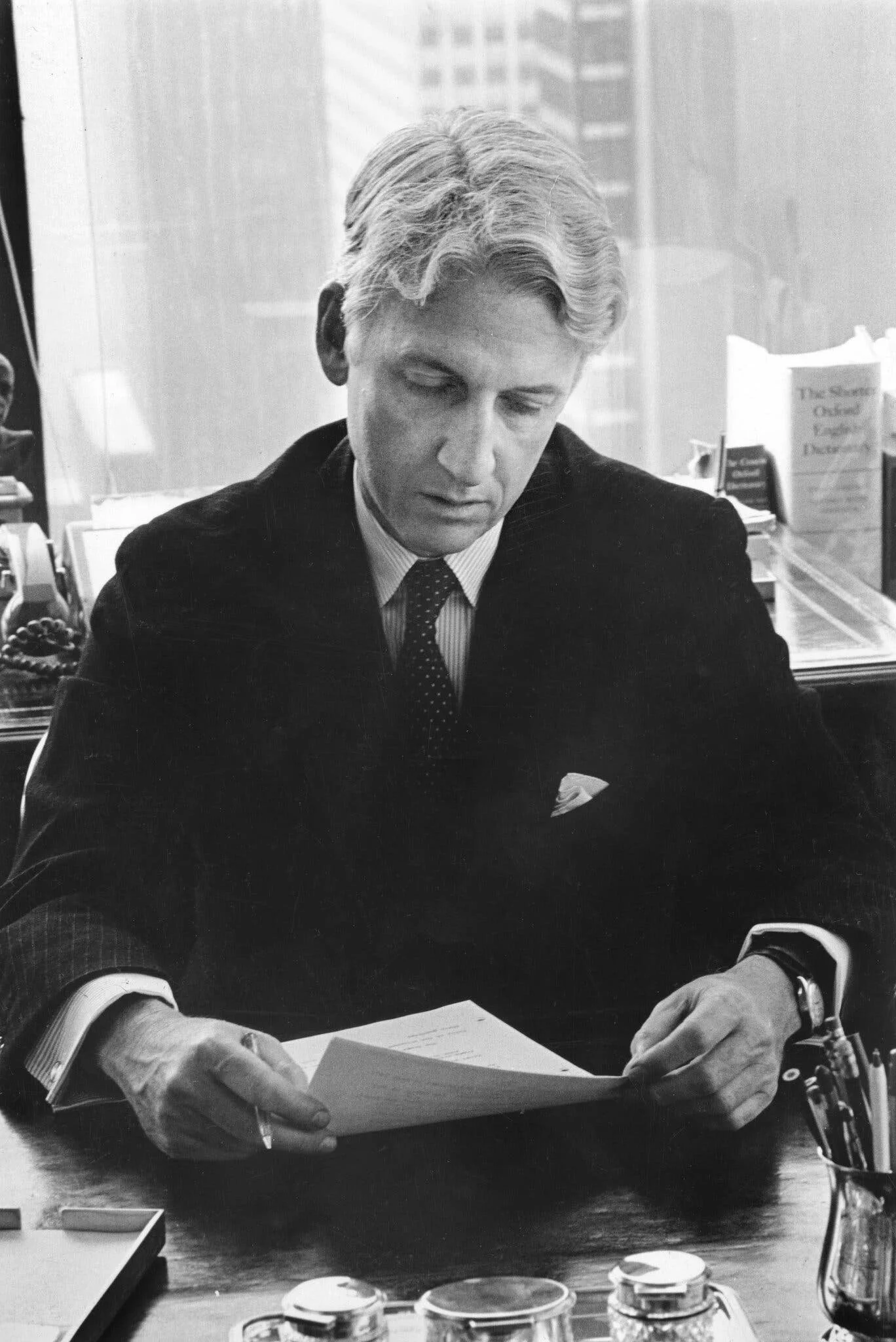
John Train contracted with the CIA on various projects for over 30 years
John Pell Coster Train was a Harvard-educated, multimillionaire investment banker and a founder of the literary magazine, The Paris Review. The Review was co-founded by CIA agent Peter Matthiessen in 1953. The magazine’s editor, George Plimpton, was later outed as a CIA “agent of influence”. The magazine published (and sidelined) certain articles in an attempt to control the cultural narrative in the US’ fight against communism.
Prince Sadruddin Aga Khan served as the publisher of The Paris Review on paper, but never put up a penny. The CIA funneled funds though Khan’s foundation to publish the magazine. Khan, a French-born statesman and son of a Pakistan-founding father, attended Harvard. His college roommate was: John Train.
In the 1980s, Khan became co-ordinator of the UN Humanitarian and Economic Assistance Programs relating to Afghanistan. Therein, Khan and Train funneled CIA money to help train the Mujahideen in their fight against the Soviet Union.
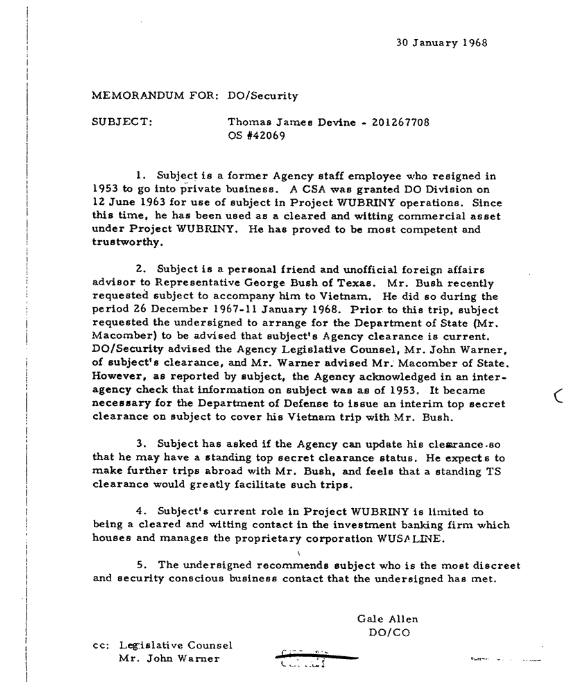
But long before this, Train was a “fully cleared and witting” asset for the CIA. Various now-declassified CIA documents list cryptonyms WUSALIFY (Train, Cabot & Associates, Train’s investment banking firm) and WUSALINE (International Capital Corporation [ICAP], a CIA proprietary corporation housed and managed by Train, Cabot & Association). Train even had his own cryptonym: WUBRINY-1.
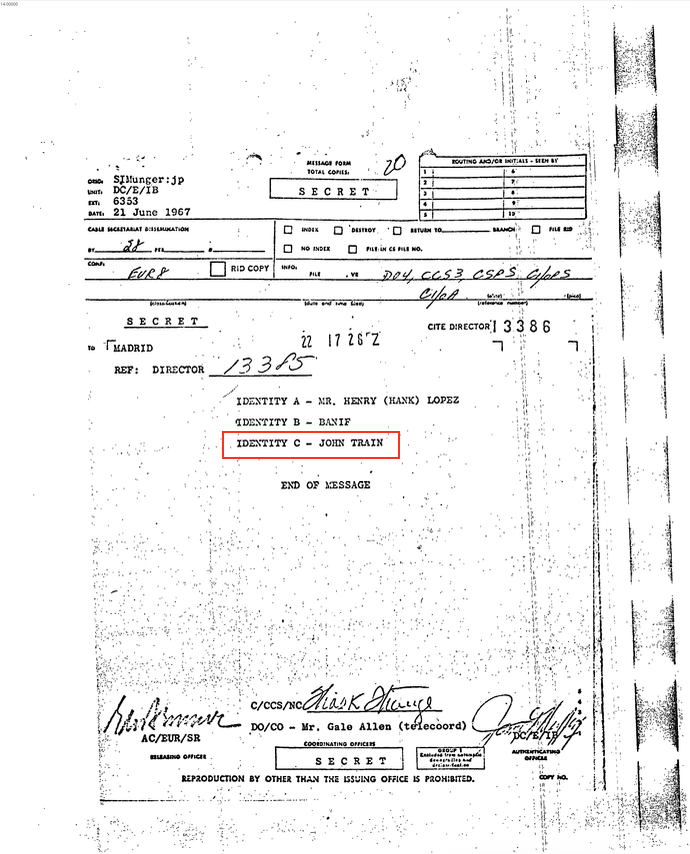
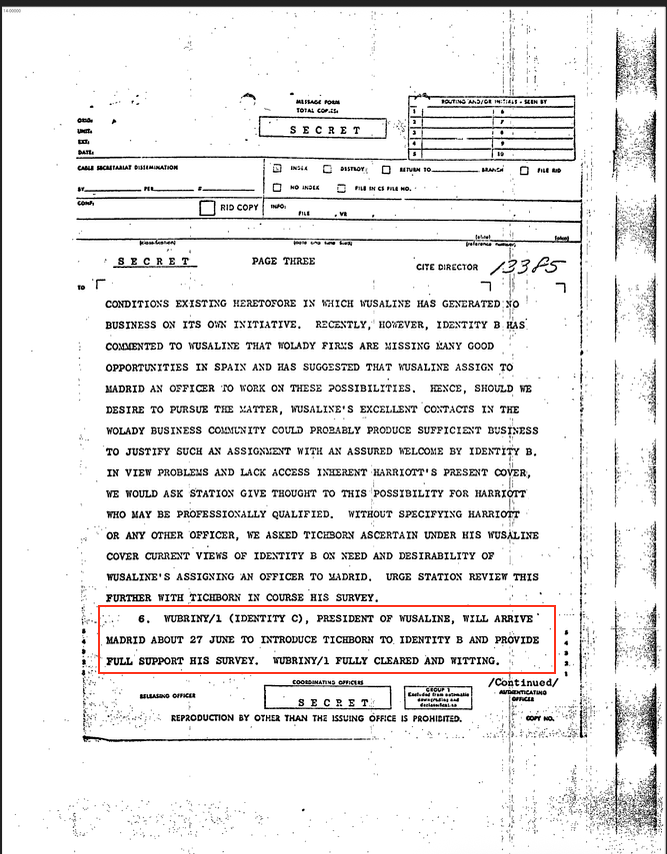
Declassified CIA documents identifying John Train as WUBRINY-1, “fully cleared and witting” (Courtesy of the Mary Ferrell Foundation)
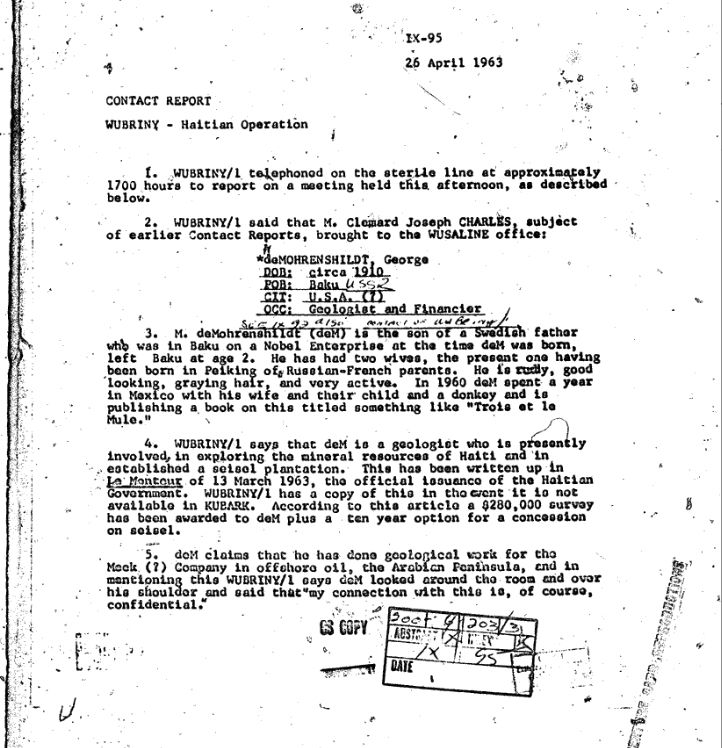
Train also had contact with some interesting characters surrounding the Kennedy assassination. Documents show Train was in contact with George de Mohrenschildt (one of Lee Harvey Oswald’s close associates and likely handler) in early 1963 in Haiti.
Train’s WUSALINE company would later provide cover for Thomas Devine, a “former” CIA officer and business partner of George HW Bush.
Given all the info above, is it possible Phil Ochs knew the “real” John Train was a bad character? Could they have had some contact at some point— given Train seems to have become “witting” as early as the mid-50s (around the time Ochs left his private military high school to join ROTC at Ohio St.)?
Was Ochs’ adopting Train’s name a way of him subconsciously succumbing to the military coup that forever changed the direction of America on 11/22/63? To get rid of this protest singer who needed to be killed, “for the good of societies, public and secret”?
WAS PHIL A SPY?
Suppose that all of this is true: that Phil Ochs was involved in a campus spying program at Ohio State, that he heard from military intelligence contacts about the Kennedy assassination before it happened, and that he was in Dealey Plaza when the murder happened- one enormous question remains:
What does this mean for the legacy of Phil Ochs?
Without question, Ochs’ determination in seeking truth, believing in democracy and freedom, and relentlessly fighting for a more peaceful world, were foundational aspects of his personality and his life’s work. The long arm of intelligence stretches far and wide in America and it always has. The majority of Americans would be shocked to know the extent to which the intelligence agencies and the military have dipped their toes into cultural affairs. In the end, it’s culture that influences people more than law. So, from their tyrannical, agenda-setting perspective, they’d be fools not to have contacts all over the entertainment industry. But, that doesn’t mean everyone involved always knows the full extent of what it is they’re getting involved in.
If anything, Phil’s being in Dealey Plaza and refusing to stay quiet, refusing to shut up like they demanded of him, makes him infinitely more heroic. Phil had the courage to stand by his principles and continue to be a very public, outspoken critic of the military industrial complex. And his (and his generation’s) inability to course correct the country was ultimately what destroyed him. Bob Dylan shied away from politics just month’s after the Kennedy assassination, presumably without military intelligence contacting him at all.
Phil Ochs is the most strident and tenacious protest songwriter of the 1960s, without any of this backstory.
With it, he’s an unparalleled titan of 20th century protest history.
In a rare television appearance for Phil, he was a guest on Murray the K’s show, The Sound is Now in 1968. In this clip, Phil is chastised for his songwriting by an obviously planted college student (who is so nervous he doesn’t ask his prescribed question correctly, so Murray has to follow up and clarify), an Episcopalian priest who calls Phil selfish and finally, Tex McCrary, a World War II veteran, Yale graduate and member of Skull and Bones.
All of this information and more is compiled in our forthcoming documentary, Psychic Cowboy.
If you’d like to learn more about the project, please email: scrapyardpictures@gmail.com
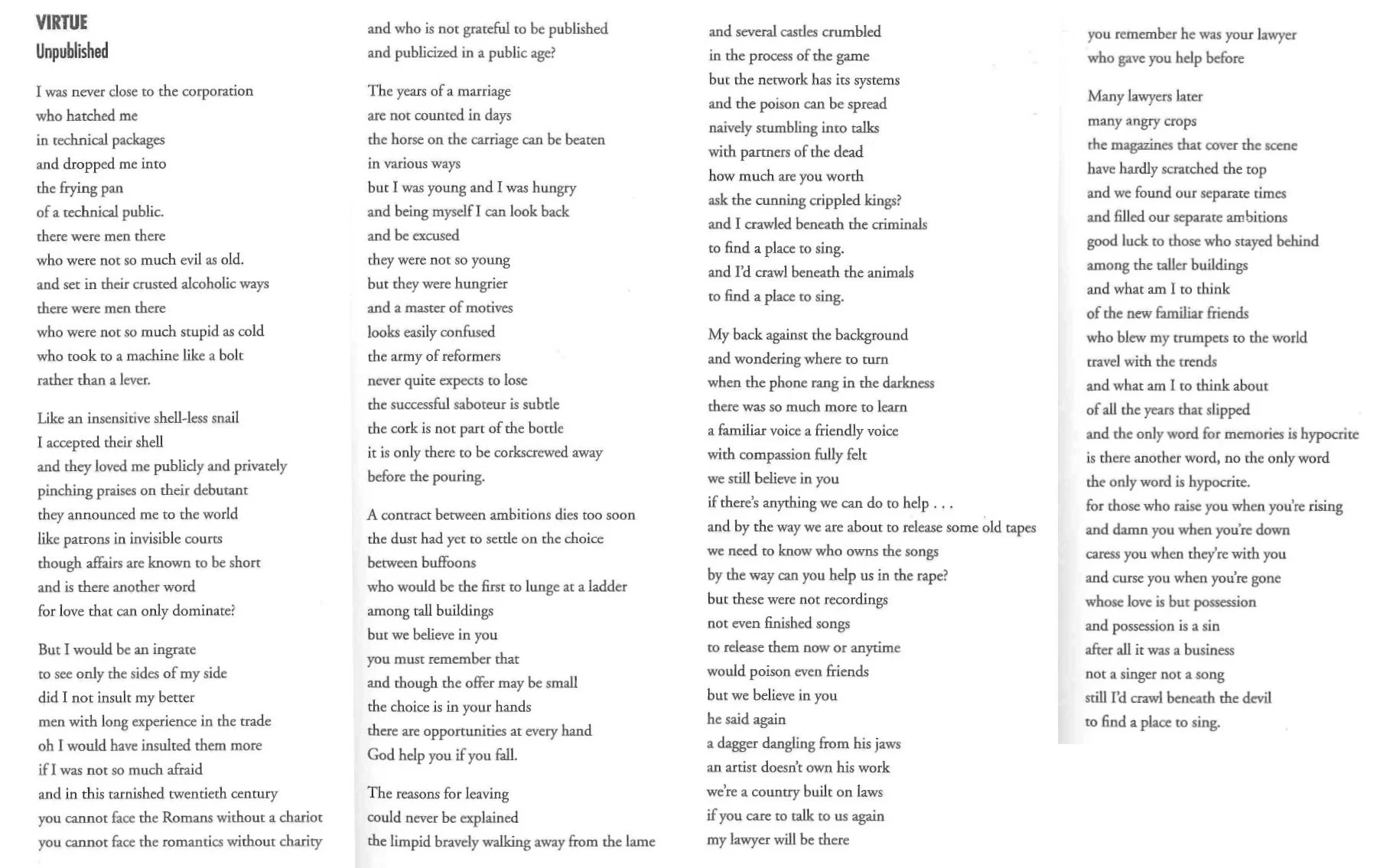
I’m Gonna Say It Now, a collection of Ochs’ poems, articles and journal entries was published in 2020. In it is a previously unreleased poem that is as close as Phil would ever come to telling his full story: